Pipe fractured in Pine County explosion was ‘susceptible to integrity issues’

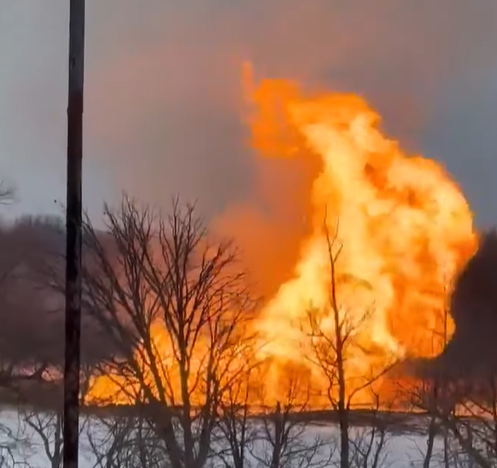
Willow River Pipeline Explosion
(Carlton County Fire News)
(Carlton County Fire News)
PINE COUNTY, Minn. – The United States Pipeline and Hazardous Materials Safety Administration (PHMSA) is overseeing the investigation into the natural gas pipeline explosion that happened in Pine County. Following the January 16, 2026 pipeline failure near Willow River, Minnesota, the federal agency issued a “Corrective Action Order”. The order was sent on the day following the explosion.
It did not point at an initial theory on what caused the explosion, but it did point at a possible reason. The PHMSA order on the explosion says, “The pipe at the Failure location is 20-inch diameter pipe manufactured in 1959 with API 5L X52 low frequency electric resistance welded (LF-ERW) longitudinal seam manufactured by Youngstown. LF-ERW pipe of this vintage is known to be susceptible to integrity issues.”
The order tells Northern Natural Gas Company, who owns the pipeline that exploded, to fix the problem and investigate what happened.
A US DOT Fact Sheet on the “Pipe Manufacturing Process” looked at that type of pipe. Specifically, the low-frequency weld. It said, “Over time, the welds of low-frequency ERW pipe were found to be susceptible to selective seam corrosion, hook cracks, and inadequate bonding of the seams, so low-frequency ERW is no longer used to manufacture pipe. The high frequency process is still being used to manufacture pipe for use in new pipeline construction,” It said, “this low frequency process was used from the 1920’s until 1970. In 1970, the low-frequency process was superseded by a high-frequency ERW process, which produced a higher quality weld.”
Federal guidance says operators with systems containing low-frequency ERW pipes must manage the risk of those types of pipes – especially in heavily populated areas. These actions could include increased monitoring through various inspection and testing methods, and pressure reductions, or replacement.
FOX 21 talked to the Director of the Institute for Corrosion and Multiphase Technology at Ohio University Dr. Srdjan Nesic. He said pipeline failures can happen in many different ways and have multiple causes, “In terms of type of failure, can be formed from chemical degradation, which usually we refer to as corrosion. Where the material of the pipeline, steel is attacked and then slowly degraded over time. Or it could be mechanical, where the stress in a pipeline typically due to pressure inside lead to failure of the line, where it mechanically disintegrates. Or as it often happens, you can have both working at the same time.”
Dr. Nesic added that pipes don’t just fail. Something has to lead to the failure, “You could take some piece of steel that was made 100 years ago. It was sitting on a shelf, and you look at it, it’s basically going to be the same as it was 100 years ago.” He continued, “When they say pipes age, or pipelines age, they mean there was some kind of consistent, persistent, long term attack, chemical or chemo-mechanical, that where the damage accumulated over the years, where the pipe thinned over the years, where the weld slowly, you know, got eaten out over the years, and then eventually led to failure.”
Northern Natural Gas Company Deputy General Counsel Britany Shotkoski told FOX 21, “Northern Natural Gas has a robust pipeline integrity management program to ensure the safety and reliability of its pipeline system as well as to comply with the laws and regulations that govern pipeline safety and integrity. Northern Natural Gas has an extensive Asset Modernization Program that is being executed. Northern Natural Gas’ Asset Modernization Program was developed nearly a decade ago to address vintage facilities and integrity risk. Since 2016, Northern has made capital investments of over $4.2 billion in projects to modernize and enhance the efficient, safe and reliable operation of its pipeline and associated facilities. The incident investigation by Northern Natural Gas and the Department of Transportation is ongoing, and corrective action will be taken as needed.”

Northern Natural Gas Logo
The order said Northern Natural Gas Company in 2021 ran inline inspection tools through the pipe in the area where it failed in 2026. The order did not say what the 2021 inspection found.
PHMSA says Northern Natural Gas Company by early March 2026 must “complete mechanical and metallurgical testing and failure analysis of the failed pipe, including an analysis of soil samples and any foreign materials.” Northern Natural Gas Company is also tasked to “complete a root cause failure analysis and submit a final report” within 90-days from January 17, 2026. Their report must have independent third-party support.
Within four months and one day from the explosion, Northern Natural Gas Company must also submit a “Remedial Work Plan”. That plan “must consider both the risk of another failure and the consequence of another failure to develop a prioritized schedule” for that work. They must review many things in the Remedial Work Plan to “determine if conditions similar to those contributing to the failure on January 16, 2026, are likely to exist elsewhere.”
It also gave an updated number of “approximately 830 customers being affected.” The PHMSA order did confirm there were no reported injuries from the explosion.
The order described the explosion, saying, “the released natural gas caught fire in two locations approximately 1,000 feet apart.”
Data from the US DOT says as of 2024, there were still 3,072 miles of pre-1970 pipe in Minnesota; There were 209 miles of pipeline that have an unknown vintage.